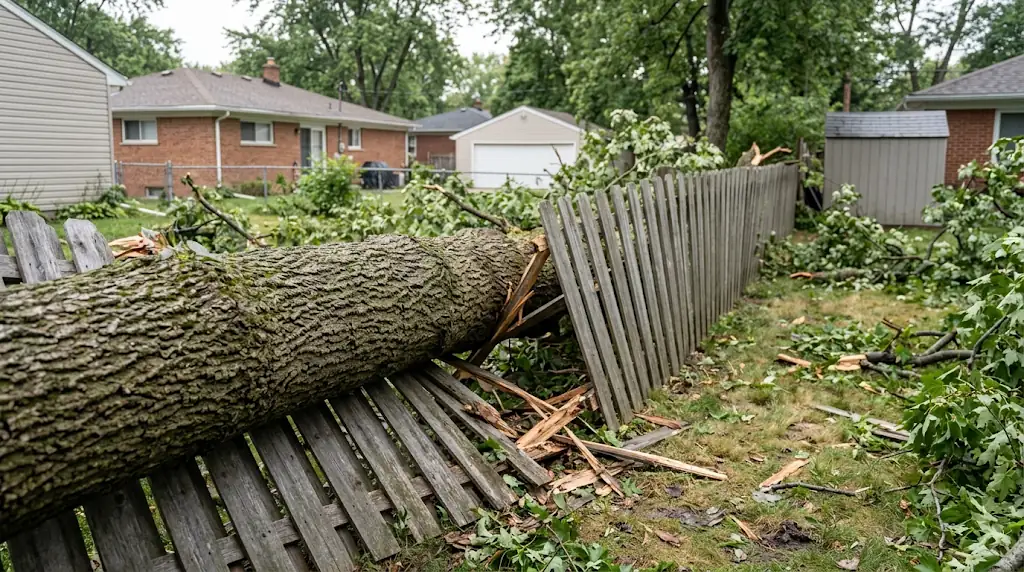
Under Michigan law, if a neighbor’s healthy tree falls into your yard due to severe weather, you and your homeowners insurance are legally and financially responsible for removing the debris on your side of the property line. Your neighbor is financially liable only if the tree was visibly dead, diseased, or unstable prior to the failure and you can document that they failed to exercise reasonable care to remove the hazard.
Michigan courts treat severe windstorms, heavy wet snow, and ice-load events as “Acts of God.” In these occurrences, property boundary lines—not tree trunk origination—dictate cleanup obligations.
Michigan Liability Matrix: Weather Event vs. Property Owner Negligence
Responsibility shifts based on the structural condition of the timber prior to failure, where the trunk lands, and whether an insured structure sustained physical impact.
| Scenario | Primary Responsible Party | Insurance Coverage Source | Governing Legal Standard |
| Healthy tree falls on your home/garage | You (Affected Property Owner) | Your Homeowners Insurance (Coverage A or B) | Michigan Common Law (“Act of God” doctrine) |
| Healthy tree falls across your open lawn (no structures hit) | You (Affected Property Owner) | Out-of-pocket (Insurance typically denies debris-only claims) | Michigan Common Law; property boundary demarcation |
| Documented dead/rotted tree falls on your property | Neighbor (Tree Owner) | Neighbor’s Personal Liability Coverage via Subrogation | Tort Negligence / Failure to mitigate a known hazard |
| Healthy tree falls onto your vehicle parked in driveway | You (Vehicle Owner) | Your Comprehensive Auto Insurance (not homeowners) | Michigan No-Fault Insurance framework |
| Boundary line tree falls (“Tenants in Common”) | Both Neighbors Shared 50/50 | Split out-of-pocket / Respective individual claims | Shared property asset under Michigan property law |
The Property Line Division Rule
When a neighbor’s tree topples across a property boundary in Western Wayne or Oakland County, the trunk is legally divided at the vertical property plane.
- Your Property Sector: You are responsible for cutting, clearing, and hauling all trunk sections, limbs, and canopy debris that rest on your side of the boundary line.
- Neighbor’s Property Sector: The neighbor is responsible only for the portion of the fallen tree, stump, and root ball remaining on their side of the deed boundary.
- Cross-Border Entry Restrictions: You cannot legally enter your neighbor’s yard to cut wood or push debris back across the property line without their express permission. Moving their fallen timber back onto their parcel without consent constitutes private trespass under Michigan law.
When Homeowners Insurance Pays for Tree Removal in Michigan
According to the Michigan Department of Insurance and Financial Services (DIFS), standard ISO HO-3 homeowners insurance policies cover tree debris removal only under specific conditions.
1. The Covered Structure Rule
Insurance will not pay to remove a fallen tree simply because it is large, unsightly, or killing your turfgrass. The fallen tree must strike and damage a covered, insured structure—such as your primary dwelling, attached garage, detached workshop, garden shed, or perimeter fence. If no insured structure suffers physical damage, the policy pays zero dollars toward debris removal or log hauling.
2. The Ingress/Egress and Driveway Exception
Most standard policies include an emergency accessibility endorsement. If a fallen tree from a neighboring parcel blocks your driveway, preventing personal vehicle entry or exit, or blocks a designated handicap access ramp, insurers approve debris removal up to policy limits to clear a functional travel lane, even if the driveway concrete suffered no physical breakage.
3. Policy Caps and Deductible Calculations
Insurance policies strictly cap tree debris removal payouts. The typical Michigan homeowner policy limits debris extraction coverage to $500 to $1,000 per individual tree, capped at a maximum of $1,000 to $2,500 per storm occurrence.
If removing a 70-foot fallen Silver Maple from your yard in Livonia or Redford costs $1,800, your insurer caps the debris reimbursement at $500 to $1,000. You remain out-of-pocket for your standard deductible (typically $1,000 to $2,500) plus any removal balance exceeding the sub-limit.
Proving Neighbor Negligence: Establishing Legal Fault
To force a neighbor or their insurance carrier to cover 100% of the extraction and property damage costs, you must clear the legal threshold for premises negligence under Michigan tort law.
You must substantiate three factual conditions:
- Pre-Existing Hazard: The tree possessed visible, documented structural defects—such as widespread crown dieback, visible trunk cavities, large dead hanging limbs, fungal conks (bracket fungi) at the base, or severe lean caused by root plate failure.
- Constructive or Actual Notice: The property owner knew, or a reasonable property owner should have known, that the tree posed an imminent risk of failure.
- Failure to Mitigate: The owner took no reasonable action to hire a professional tree contractor to fell, cable, or prune the hazard prior to the storm.
How to Build a Defensible Notice File
If you live in Canton, Plymouth, Farmington Hills, or Novi and observe a hazardous neighbor tree threatening your home, protect your future legal standing through written documentation:
- Retain an International Society of Arboriculture (ISA) Certified Arborist to perform a formal Tree Risk Assessment (TRAQ).
- Mail a copy of the arborist’s risk assessment along with date-stamped photographs to the neighbor via USPS Certified Mail with Return Receipt Requested.
- Retain the green return receipt card. If the tree collapses in a subsequent storm, this paper trail prevents the neighbor’s insurance carrier from claiming the event was an unforeseen “Act of God,” enabling your insurer to execute full subrogation.
Overhanging Limbs and Preventative Rights Under Michigan Law
Michigan property owners possess the common law right of “self-help” regarding encroaching vegetation. You do not have to wait for a neighbor’s tree to collapse to protect your property.
- Vertical Pruning Rights: You may prune branches, limbs, and subterranean roots that cross your boundary line up to the vertical property plane.
- The Health Exception: Your pruning cannot destroy the structural balance, sever primary structural roots, or kill the tree.
- The Treble Damages Trap (MCL 600.2919): Under the Michigan Revised Judicature Act of 1961, any person who cuts down, despoils, or injures trees on another person’s land without legal authority is liable to the owner for three times the amount of actual damages sustained. Pruning across the property boundary line or cutting limbs so aggressively that the neighbor’s tree dies exposes you to statutory treble damages and civil litigation.
Immediate Action Steps When a Neighbor’s Tree Falls on Your Property
Execute these procedures immediately following an incident in the western suburbs:
- Safety and Utility Clearance: Inspect overhead lines. If the tree contacts wires, stay at least 35 feet away and immediately notify DTE Energy to de-energize and clear the drop lines.
- Date-Stamped Visual Documentation: Take wide-angle and close-up photographs and high-definition video of the trunk, root ball, broken branches, property lines, and structural damage before any chainsaw cuts occur.
- Notify Your Own Insurer First: Open a claim with your property insurance carrier. Provide the adjuster with the neighbor’s contact information and any prior correspondence regarding the tree’s health.
- Obtain an Itemized Tree Service Proposal: Require your contractor to provide separate line-item totals for “structural extraction” (lifting timber off roofs or fences to mitigate loss) versus “ground debris hauling” (chipping and disposal). Insurers process these line items under different coverage allowances.
To clear fallen timber, mitigate roof damage, or evaluate hazardous boundary trees across Livonia, Canton, Plymouth, Westland, Redford, Farmington Hills, and Novi, visit the contact page to request rapid on-site service from Livonia Tree Removal.