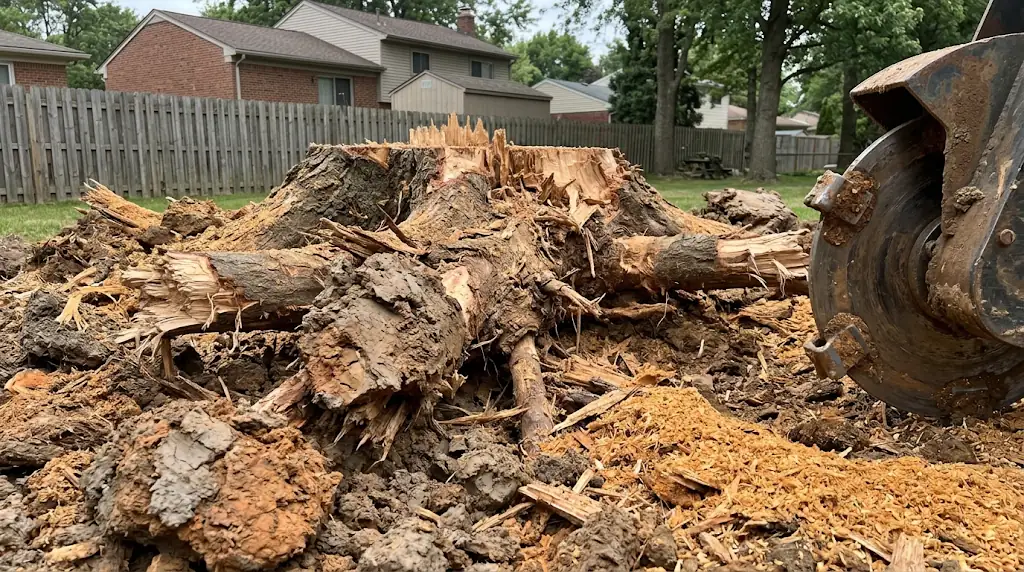
For standard residential lawn restoration, stump grinding to 6 to 10 inches below grade is the superior method because it eliminates the visible hazard while preserving the structural integrity of Metro Detroit’s dense clay soil. Complete root excavation is necessary only when preparing a site for concrete foundations, building additions, swimming pools, or underground utility trenches, as ripping root balls out of glacial clay creates massive drainage depressions and costs three to four times more than grinding.
Excavating an entire root system in Southeast Michigan alters the subsoil hydrology of your yard. Understanding the mechanical differences between grinding and full extraction prevents structural settling, water ponding, and unnecessary excavation expenses.
Stump Grinding vs. Full Root Excavation
Evaluating the mechanical footprint, budget, and soil disturbance clarifies which extraction method matches your site goals.
| Operational Metric | Professional Stump Grinding | Complete Mechanical Root Excavation |
| Typical Cost Range | $60 – $350 (based on diameter) | $1,200 – $3,500+ (equipment and labor) |
| Extraction Depth | 6 to 12 inches below turf grade | 3 to 6 feet below grade (entire root plate) |
| Equipment Deployed | Tracked or wheeled stump grinder | 5- to 10-ton mini-excavator or backhoe |
| Lawn Surface Disturbance | Confined strictly to stump radius (3–5 ft) | Severe disturbance across a 12- to 20-foot radius |
| Subsoil Void Created | Shallow depression filled by mulch/chips | Massive subgrade crater requiring tons of fill dirt |
| Utility Strike Hazard | Low (confined to shallow surface soil) | Extremely high (rips through utility easements) |
| Primary Use Case | Turf reseeding, flowerbeds, aesthetics | New construction, footings, paving, pools |
Soil Mechanics: The Behavior of Glacial Clay in Western Wayne and Oakland County
The western suburbs of Metro Detroit—including Livonia, Canton, Plymouth, Westland, Redford, Farmington Hills, and Novi—are situated predominantly on glacial lake plain clays (such as the Hoytville, Toledo, and Fulton soil series). These soils feature very fine particles, minimal pore space, and exceptionally high moisture retention.
The “Clay Bowl Effect”
When an excavator digs up an entire tree stump and its primary root plate, it extracts a root ball measuring 8 to 15 feet wide and 3 to 5 feet deep. In dense clay soil, this leaves a smooth, impermeable subterranean pit.
If this crater is backfilled with porous topsoil, sand, or uncompacted fill dirt, it creates a subterranean retention basin known as the “clay bowl effect.” Rainwater and snowmelt filter down through the loose fill and hit the surrounding impervious clay walls, unable to percolate outward. The hole fills with stagnant water, destabilizing the surface lawn, causing severe settlement hollows over several years, and rotting the roots of any new turf or landscape plantings.
Preserving Subsoil Load-Bearing Capacity
Grinding the stump avoids this structural collapse. The grinding wheel pulverizes the trunk core and root flare down to 6 to 10 inches below the turf, leaving the deep subterranean lateral roots untouched.
In low-oxygen clay, these deep roots break down slowly over 7 to 12 years. As they decay, the surrounding clay soil compresses and fills the micro-voids gradually, preventing the massive, sudden surface drop-offs caused by mechanical backfilling.
Root Architecture in Western Suburban Canopies
Suburban homeowners often assume tree roots mimic an underground mirror image of the canopy, growing straight down as deep taproots. In Southeast Michigan clay, this assumption is false.
- Shallow Lateral Networks: Because Metro Detroit clay lacks oxygen and drainage deeper than 24 inches, over 90% of a tree’s root system is concentrated within the upper 12 to 18 inches of soil.
- Surface Root Spread: Fast-growing surface-rooting species—such as Silver Maples, Cottonwoods, and Siberian Elms in Livonia and Westland—spread root plates horizontally two to three times the width of the branch canopy.
- Targeted Flare Grinding: A professional stump grinder does not just grind the central cut trunk. Operators sweep the grinding wheel along the prominent surface root flares radiating outward from the trunk base. This eliminates lawnmower blade strikes, tripping hazards, and unsightly surface roots without disturbing the underground root plate.
Cost Realities: Why Excavating Costs 300% More
Stump grinding is an efficient, single-operator process. Complete root excavation is a major earthmoving operation that carries extensive logistical overhead:
- Machine Mobilization: A stump grinder enters backyards through standard 36-inch pedestrian gates on lightweight turf-friendly rubber tracks. Moving an excavator onto a property requires wide fence removals, ground-protection mats, and multi-ton transport trailers.
- Clay Disposal Surcharges: Commercial dump sites charge by weight. A 40-inch stump pulled from sandy soil sheds its dirt easily. A 40-inch stump pulled from Canton or Farmington Hills clay is encased in thousands of pounds of heavy, wet, sticky clay that cannot be shaken loose. Landfills and recycling yards assess heavy surcharges for clay-caked stumps.
- Engineered Fill Dirt and Compaction: Backfilling an excavation crater requires importing multiple yards of clean structural fill dirt and topsoil, followed by mechanical plate compaction in 6-inch lifts to prevent future sinkholes.
Legal and Utility Constraints: MISS DIG 811 Mandate
Ripping subterranean roots out of suburban soils carries severe underground utility strike risks.
Under Michigan Public Act 174 of 2013, anyone performing powered mechanical earth disturbance is legally required to contact MISS DIG 811 at least three full business days prior to digging.
- Front Yard Utility Corridors: In densely settled suburbs like Livonia, Redford, and Plymouth, front yards contain primary water service lines, natural gas service drops, sewer laterals, and buried telecommunications cables. Tree roots frequently grow around and encase these utility lines.
- Root Tear Damage: Using an excavator to pull a stubborn root plate applies thousands of pounds of hydraulic force. If a lateral root has encircled an underground gas line or sewer lateral, pulling the stump shears the utility line clean off the municipal main, triggering emergency evacuations and substantial homeowner liability.
- Grinding Safety: Stump grinding operates within the top 6 to 10 inches directly above the stump base, where public utilities rarely cross, significantly reducing line strike risk after MISS DIG clearance is established.
Can You Replant a Tree After Stump Grinding?
You cannot plant a new tree directly in the exact hole left by a freshly ground stump.
When a stump is ground down, the process generates a massive volume of coarse wood shavings mixed with clay soil. As soil bacteria and fungi break down this raw cellulose, they consume all available soil nitrogen (nitrogen drawdown). Any new sapling placed directly into this wood-chip slurry will starve of vital nutrients and suffocate.
The Correct Replanting Rules:
- The 5-to-10-Foot Offset: The simplest, most effective approach is to plant the new tree 5 to 10 feet away from the ground stump location. This places the young sapling into undisturbed native soil with balanced nutrient profiles.
- Site Preparation for Turf: Rake out 70% to 80% of the wood mulch from the ground depression. Fill the remaining void with screened, nitrogen-rich topsoil blended with organic compost. Pack the soil firmly, apply a standard starter fertilizer, and seed with a sun-shade Kentucky Bluegrass/Perennial Ryegrass blend.
- Immediate Replanting on the Exact Site: If property setbacks dictate that the new tree must sit in the exact same footprint, the stump must be fully ground to a depth of 12 to 18 inches. All wood shavings must be shoveled out completely, and the crater must be backfilled entirely with fresh, high-quality topsoil.
To eliminate hazardous stumps, preserve your yard’s clay soil stability, or assess large root systems across Livonia, Canton, Plymouth, Westland, Redford, Farmington Hills, and Novi, visit the contact page to schedule an on-site property evaluation with Livonia Tree Removal.