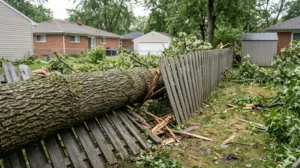
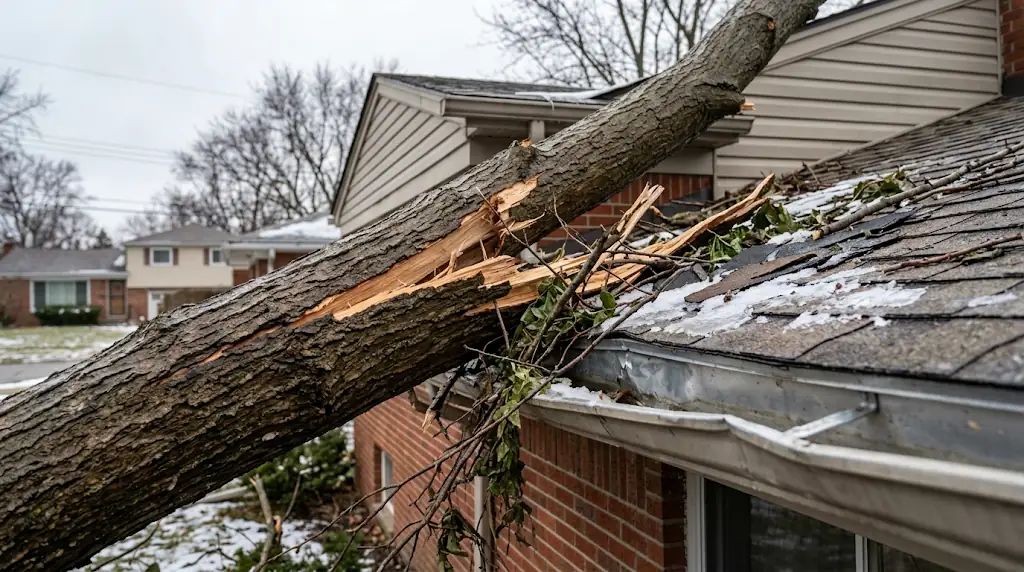
Yes, standard Michigan homeowners insurance covers emergency tree removal, but only if the fallen tree strikes and physically damages an insured structure—such as your house, garage, shed, or perimeter fence—or completely blocks your driveway. If severe wind or freezing rain topples a tree onto your open lawn without damaging an insured structure, standard policies pay zero dollars toward removal and debris hauling.
When coverage applies, insurance settlements divide the loss into structural repairs and debris removal. Debris removal carries rigid policy sublimits that dictate how much of the tree service bill is reimbursed.
Michigan Storm Coverage Matrix: What Insurance Pays
Homeowners insurance responds to sudden and accidental perils. Payouts depend strictly on where the timber lands and what property suffers physical impact.
| Storm Impact Scenario | Insurance Coverage Status | Relevant Policy Section | Average Payout / Financial Limit |
| Tree crushes roof, porch, or siding | Covered | Coverage A (Dwelling) + Debris Removal | Structure repair up to policy limit; removal capped at $500–$1,000 |
| Tree flattens detached garage or shed | Covered | Coverage B (Other Structures) | Structure repair (typically 10% of Coverage A); removal capped |
| Tree falls cleanly across turf/garden | Not Covered | None (Exempt Loss) | $0 (Homeowner pays 100% out-of-pocket) |
| Tree blocks residential driveway | Covered (Limited) | Additional Coverage: Debris Removal | $500 – $1,000 cap to clear a single vehicular travel lane |
| Tree crushes private vehicle in driveway | Covered by Auto | Comprehensive Auto Insurance (not home policy) | Actual cash value / repair cost minus auto deductible |
| Neighbor’s tree falls onto your house | Covered | Your Homeowners Policy (Coverage A) | Your insurer pays repairs and removal; subrogation pursued if neighbor was negligent |
Understanding Policy Sublimits: The Debris Removal Cap
According to the Michigan Department of Insurance and Financial Services (DIFS), standard HO-3 homeowners insurance policies enforce strict dollar sublimits on tree debris extraction.
Homeowners routinely confuse structural extraction with debris hauling:
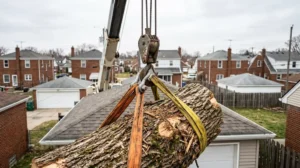
- Structural Triage (Covered Under Dwelling / Coverage A): When a 70-foot Silver Maple crushes your roof rafters, crane-assisted rigging to lift the trunk off the house is billed under structural emergency mitigation. Insurers pay reasonable crane and extraction charges to prevent further weather intrusion, collapse, and water damage.
- Debris Hauling and Chipping (Capped Under Debris Removal): Once the tree sits safely on the turf, cutting the trunk into firewood rounds, feeding branches through a wood chipper, and trucking the timber away falls under “Debris Removal.” Standard Michigan policies cap debris cleanup at $500 to $1,000 per tree, with an aggregate disaster cap of $1,000 to $2,500 per storm occurrence.
- Stump Grinding (Excluded): Insurers treat stump grinding as cosmetic yard restoration. Homeowners insurance policies do not pay to grind or excavate stumps below ground level, even if the tree crushed a home.
Metro Detroit Storm Realities: Ice Loads and High Winds
Western Wayne and Oakland County experience distinct storm phenomena that trigger mass tree failures.
Freezing Rain and Glaze Ice Loading
Southeast Michigan sits in an active storm corridor where warm Gulf moisture overrides polar air masses, producing destructive freezing rain events. Radial ice accumulations between 0.25 and 0.5 inches increase branch weight by a factor of 10 to 30.
- Livonia, Westland, and Redford: Older neighborhoods feature brittle, fast-growing canopy trees—specifically Silver Maples, Siberian Elms, and Green Ash—planted during mid-century residential expansion. Weak branch unions and internal rot pockets snap under 0.5-inch ice loads, shearing canopy sections onto power drops and garage roofs.
- Farmington Hills and Novi: Heavily wooded tracts and rolling terrain expose mature Red Oaks and Eastern White Pines to severe radial ice loads. Pines hold snow and ice on needles, creating top-heavy levers that uproot trees from saturated soils.
Severe Summer Windstorms and Microbursts
Summer squall lines and derecho events frequently generate straight-line winds between 50 and 70+ mph across the western suburbs. These winds apply dynamic shear loads to full leaf canopies. In Canton and Plymouth, where expansive clay soils restrict root systems to the top 18 to 24 inches of earth, wind-driven leverage flips entire root plates, exposing underground utility lines and crushing rear fences.
The “Neglect” Exclusion: When Insurers Deny Storm Claims
Insurance carriers cover damage from “sudden and accidental” weather perils, not pre-existing homeowner neglect. When a storm topples a tree, field adjusters inspect the fractured wood, trunk hollows, and root plate before authorizing claim payouts.
Insurers deny claims or adjust settlements under these documented conditions:
- Pre-Existing Dead Timber: If a dead, leafless tree stood in your yard for two consecutive seasons and finally blew over during a 40 mph gale, adjusters identify the failure as long-term decay, not a storm loss.
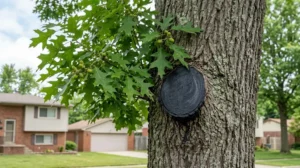
- Visible Fungal Conks and Trunk Cavities: Structural wood rotted by bracket fungi (Ganoderma) or wide hollows that reduce trunk wall thickness below 30% are treated as unmaintained hazards.
- Failure to Mitigate: If a fallen branch punches a hole through your roof deck and you fail to tarp the opening, insurers cover the initial puncture but deny subsequent water damage to drywall, hardwood floors, and electrical panels.
Homeowners are legally expected to maintain private timber in structurally sound condition through routine arborist inspections and deadwood removal.
Power Line Storm Hazards: DTE Jurisdiction
When severe storms drop tree limbs onto electrical infrastructure, clear boundaries dictate who clears the scene.
DTE Energy clears downed timber only to the extent necessary to restore electrical service and de-energize downed high-voltage lines. If an ice-laden tree falls across primary pole-to-pole lines and crashes into your yard:
- DTE line crews saw the tree away from the energized conductor, leave the remaining trunk and shattered canopy on your lawn, and leave.
- DTE does not chip brush, haul logs, or perform yard cleanup after storms.
- Private tree contractors cannot touch trees entangled with downed power lines until DTE emergency crews arrive, cut power, and declare the site safe.
Step-by-Step Claim Protocol Following an Emergency Storm Event
Execute these steps immediately after a tree failure to preserve insurance reimbursement and speed up site recovery:
- Verify Electrical Safety: Scan the ground and canopy for downed wires. If wires are within 35 feet, keep all occupants inside and call DTE Energy and 911 immediately.
- Photograph Physical Structural Contact: Before touching anything, capture wide and close-up photos and 4K video showing where the tree trunk, branches, or root plate makes contact with your roof, gutters, siding, or detached structures.
- Authorize Emergency Structural Stabilization: Contact an insured tree removal contractor to lift heavy timber off the roofline and tarp the exterior opening. Michigan insurance contracts authorize homeowners to take immediate, reasonable steps to mitigate further property loss.
- Demand Itemized Contractor Billing: Ensure your tree contractor separates the invoice into distinct line items: Emergency Structure Triage & Crane Mitigation (paid under Coverage A) versus Brush Hauling & Debris Processing (paid under Debris Removal sublimits). Unitemized lump-sum invoices trigger automatic debris cap limits from desk adjusters.
- Retain All Cut Sections for Adjuster Review: Direct your tree crew to leave major hollow or fractured trunk sections on-site until the field adjuster inspects the timber to verify green wood integrity.
To rapidly clear fallen trees off structures, stabilize hazardous post-storm canopies, or secure itemized emergency invoices in Livonia, Canton, Plymouth, Westland, Redford, Farmington Hills, and Novi, visit the contact page to deploy emergency crews with Livonia Tree Removal.