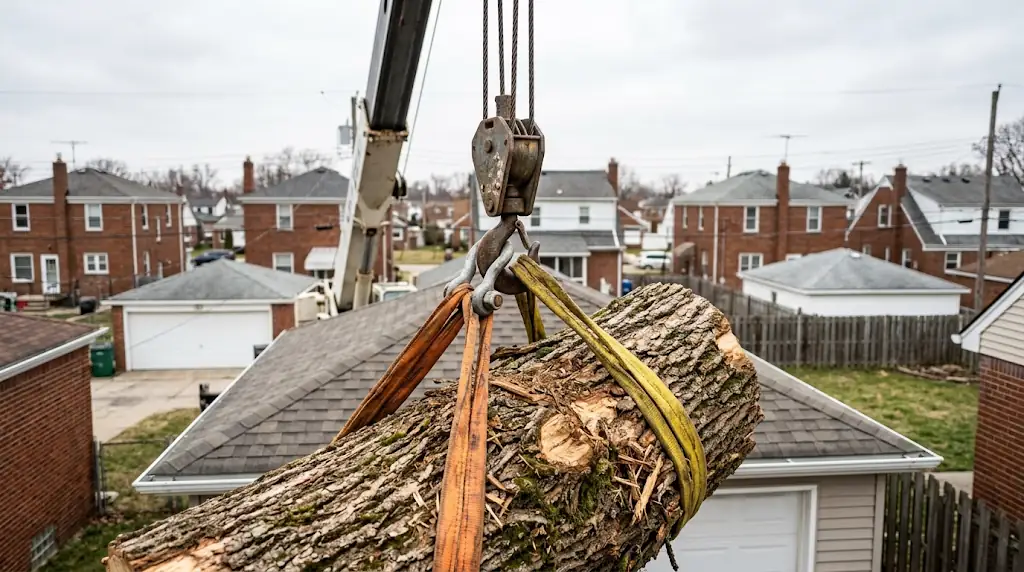
Suburban tree removal in Western Wayne County requires a crane instead of climbing when a tree is structurally compromised beyond safe tie-in load limits, or when zero-clearance drop zones make traditional ground rigging impossible without damaging adjacent structures. Utilizing an all-terrain mobile crane eliminates dynamic shock-loading forces on hollow or decaying trunks and enables crews to pick heavy timber sections vertically up and over rooftops directly to the street.
Deciding between an aerial crane extraction and a manual climber takedown is an engineering and safety calculation governed by tree stability, physical property setbacks, and equipment access.
Crane Removal vs. Manual Climbing Decision Matrix
Arborists evaluate five primary operational factors when determining whether to deploy aerial crane machinery:
| Project Variable | Standard Manual Climbing & Rigging | Crane-Assisted Removal Mandatory |
| Trunk Structural Integrity | Solid wood fiber; healthy holding wood; safe climbing anchor points | Severe heartwood rot, hollow trunk cavity, dead Ash brittle wood, or basal decay conks |
| Drop Zone Clearance | Clear yard area of at least 15 x 15 feet beneath the canopy | Zero clearance; branches directly overhang roofs, skylights, AC compressors, or pools |
| Proximity to Obstacles | Detached limbs can swing into open yard space without contact | Timber is wedged between two houses or hovering over glass conservatories |
| Crew Safety Threshold | Climber can tie off safely under OSHA 1910.269 rules | Tree cannot support a climber’s weight plus the rigging load without snapping |
| Production Speed | 1 to 2 full work days for a large 70-foot specimen | 3 to 5 hours total extraction time from setup to final pick |
| Lawn & Landscape Impact | Heavy foot traffic, dropped wood impacts, turf friction | Zero timber touches the lawn; all wood flies directly to the street |
4 Scenarios That Demand a Crane in Western Wayne County
1. Advanced Structural Decay and Brittle Deadwood
When an arborist climbs a tree, their life depends on the tree’s holding wood. Under the tree industry safety standard (ANSI Z133), an arborist cannot legally or safely tie into a tree that lacks sound structural fiber.
In communities like Livonia, Westland, and Redford, thousands of mature Green Ash trees killed by the Emerald Ash Borer have stood dead for multiple seasons. Dead ash wood loses its moisture content, becoming extremely brittle. Climbing or applying rigging forces to dead ash limbs often snaps branches without warning.
Similarly, mature Silver Maples with massive internal hollows (cavities) or basal rot cannot withstand the dynamic shock loads generated when a cut branch swings on a rigging rope. A crane eliminates this danger: the operator locks onto the cut section from above before the saw touches the bark, lifting the piece away with zero drop impact or trunk sway.
2. Zero-Clearance Lot Lines and Historic Setbacks
Western Wayne County features diverse architectural eras with tight lot constraints:
- Plymouth & Old Town: Narrow residential streets, 40-foot-wide historical parcels, detached garages, and dense fence configurations leave zero open lawn space beneath mature canopies.
- Livonia & Redford Mid-Century Subdivisions: Deep, narrow rear yards built in the 1950s feature canopies that spread across two or three adjoining properties. Dropping large limbs into neighbor yards risks destroying custom landscaping, private fences, and perimeter gardens.
- Canton & Novi Estates: Expansive home footprints, stamped concrete patios, in-ground swimming pools, and outdoor kitchens eliminate usable drop zones.
When there is no clear ground space to drop or lower cut limbs with ropes, a crane flies the branches over the house and places them directly onto the street curb or driveway for immediate chipping.
3. Leaning Trees After Ice and Wind Storms
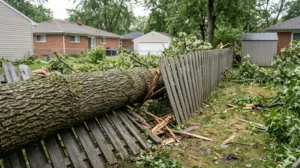
Severe ice storms and 60-mph summer squalls across Southeast Michigan frequently split dual-trunk co-dominant stems or shear root plates in heavy clay soils. A partially uprooted tree rests under massive kinetic spring tension.
Cutting a spring-loaded, leaning trunk manually can cause the butt of the tree to kick back or barber-chair vertically, endangering the sawyer. A crane stabilizes the off-balance center of mass, holding the timber secure while the tree crew severs the trunk at ground level.
4. Direct Encroachment on Overhead Electrical Service Drops
When large limbs intertwine with overhead lines, manual felling presents extreme hazards. While DTE Energy clears primary pole-to-pole transmission corridors, private 240-volt home drops remain the homeowner’s responsibility. Lowering multi-ton branches through tight wire corridors using hand lines risks snagging lines, snapping utility masts, and cutting power. Crane rigging lifts the wood vertically upward away from conductors, bypassing lines entirely.
Local Logistics: Street Permits, Glacial Clay, and Outrigger Engineering
Deploying an 80-ton mobile crane into a suburban subdivision requires precise logistical coordination.
Soil Load-Bearing Capacity in Western Wayne County
The western suburbs sit predominantly on glacial lake plain clays (such as Hoytville and Toledo soil series). Saturated clay has low shear strength. A heavy mobile crane deploying outriggers directly onto soft suburban lawns can sink or rupture underground utilities.
Professional tree services solve this through mechanical weight distribution:
- Outrigger Timber Pads: Outrigger legs rest on multi-layered composite crane mats or solid oak pads that disperse thousands of pounds of downward pressure over wide surface areas.
- Driveway Protection: Heavy polyurethane ground-protection mats line the path of travel to protect concrete driveways from surface cracks or edge spalling.
- MISS DIG 811 Verification: Crews verify the depth and location of underground water mains, private gas laterals, and septic lines before positioning outrigger feet.
Municipal Street Obstruction Permits
Because suburban driveways are often too narrow to support a full-sized mobile crane, the machine typically operates from the street curb. Setting a crane in the public right-of-way requires municipal compliance:
- In Livonia, commercial contractors must register and comply with local right-of-way standards enforced by the City of Livonia Forestry Department and the Department of Public Works.
- On county-maintained primary roads (such as Ann Arbor Road, Plymouth Road, or Merriman Road), lane closures require formal right-of-way staging permits and certified traffic-control channelization (cones, arrow boards, and flaggers) from the Wayne County Department of Public Services.
Cost Comparison: Crane vs. Traditional Manual Removal
While the equipment overhead for an all-terrain mobile crane is higher than a standard bucket truck, crane-assisted removals are often cost-competitive due to dramatic reductions in on-site labor hours.
| Cost & Efficiency Metric | Manual Climbing & Rigging Crew | Crane-Assisted Removal Operation |
| Typical Daily Equipment Surcharge | $0 – $200 (standard chipper and ropes) | $1,200 – $2,500 (crane rental and licensed operator) |
| Required Ground & Aerial Crew | 4 to 6 technicians for 1 to 2 days | 3 to 4 technicians for a single half-day |
| Average Removal Project Total | $1,800 – $3,500 (labor-heavy) | $2,500 – $4,800 (equipment-heavy) |
| Potential Turf / Property Repair Costs | $500 – $2,000 (rutted lawns, branch divots) | $0 (wood never contacts the lawn) |
| Total Property Exposure / Risk | Prolonged risk over multi-day operations | Minimized risk completed in hours |
For massive, high-risk trees hanging over roofs in Farmington Hills, Plymouth, or Canton, hiring a crane often saves money overall by eliminating post-project turf replacement, fence repairs, and multi-day labor bills.
What to Verify Before Authorizing a Crane Removal
If your property requires a crane-assisted tree extraction, verify the following credentials before signing a contract:
- NCCCO-Certified Crane Operator: Ensure the crane operator holds an active certification from the National Commission for the Certification of Crane Operators (NCCCO).
- Specific Rigging Insurance Coverage: Verify that the tree service’s General Liability policy explicitly covers “crane operations and aerial rigging.” Standard landscape policies frequently exclude heavy machinery crane lifts.
- Arborist Rigging Expertise: The tree climber or aerial sawyer making the cuts must be experienced in balance-point rigging to prevent cut logs from swinging violently into the crane boom or cables when severed.
To find out whether your hazardous, large, or storm-damaged tree requires crane-assisted dismantling, visit the contact page to schedule an on-site property and aerial-access evaluation with Livonia Tree Removal.