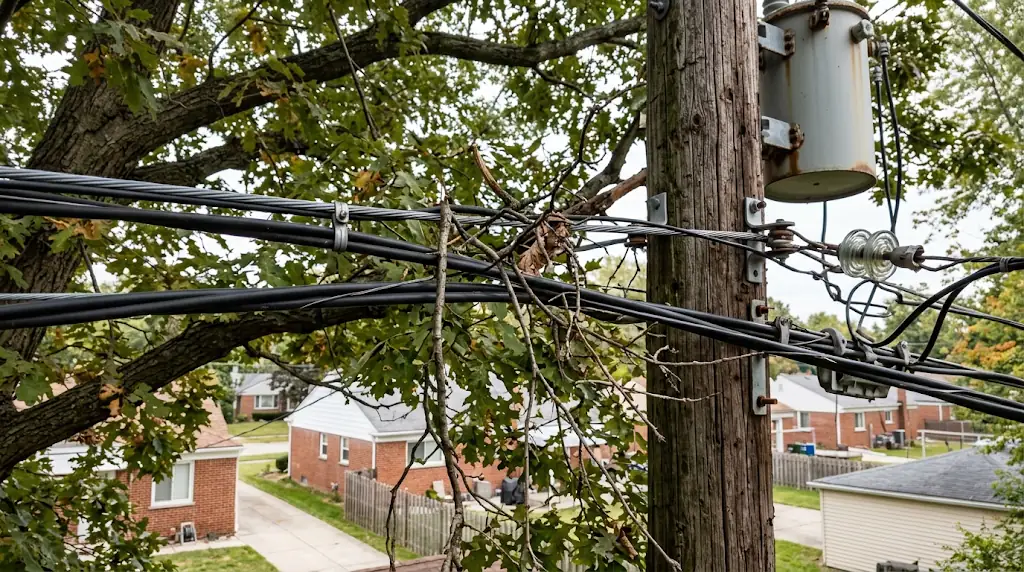
DTE Energy pays 100% of the cost to trim or remove trees interfering with primary, pole-to-pole electric distribution lines and high-voltage infrastructure within utility easements. Conversely, the homeowner is completely financially responsible for hiring and paying a private tree service to clear vegetation threatening their personal service drop—the lower-voltage line running from the neighborhood utility pole directly to the home’s electric meter.
The boundary between utility funding and out-of-pocket homeowner expense depends on the specific wire involved, the location of the tree, and whether the work involves routine grid maintenance or post-storm restoration.
DTE Energy vs. Homeowner Responsibility Matrix
Utility jurisdictions in Western Wayne and Oakland counties adhere strictly to infrastructure ownership demarcations established by the state.
| Infrastructure Component | Voltage Level | Responsible Party | Financial Burden | Debris & Wood Hauling Policy |
| Primary Distribution Lines (Pole-to-pole wires at top of pole) | High Voltage (4.8 kV to 13.2 kV) | DTE Energy | 100% DTE funded | DTE chips small brush; large wood is cut into firewood lengths and left on-site. |
| Subtransmission Lines (Major cross-city grid lines) | High Voltage (24 kV to 40 kV) | DTE Energy | 100% DTE funded | DTE crews clear complete corridor; wood left within property boundaries. |
| Private Service Drop (Pole to home weatherhead/meter) | Low Voltage (120V / 240V) | Private Homeowner | 100% Homeowner funded | Private tree contractor handles chipping, log haul-away, and site cleanup. |
| Telecommunication Lines (Lowest wires: cable/phone) | Low Voltage / Signal | Homeowner / Telecom | Homeowner or Telecom | Telecommunication providers rarely trim; homeowner handles clearance. |
| Storm-Fallen Tree on Primary Lines | Any Grid Line | DTE Energy (de-energizing and line release only) | Split (DTE frees lines; homeowner clears debris) | DTE cuts only what is necessary to rehang lines; all wood remains on homeowner’s lawn. |
Pole-to-Pole Wires vs. The Private Service Drop
Understanding which wire traverses your canopy determines whether you pay zero dollars or thousands of dollars for tree work.
1. Primary Pole-to-Pole Lines (DTE Pays)
These wires run parallel to roadways, rear-lot alleys, and municipal easements, carrying electricity from substations through neighborhoods. DTE Energy operates a continuous vegetation management program to keep these corridors open. To prevent tree-related outages, DTE contracts utility line-clearance arborists to maintain approximately a 15-foot clearance radius around all electrical conductors and infrastructure.
Homeowners cannot stop DTE from trimming or removing trees within these easements. Property owners do not receive a bill for this work, and they cannot choose the contractors used.
2. The Private Service Drop (You Pay)
The service drop is the insulated overhead cable extending from the secondary transformer on the utility pole directly to the weatherhead mast on your roof or exterior wall. Under DTE operating rules and local codes, the service drop is the homeowner’s personal connection to the power grid.
DTE does not trim or fell trees to protect the service drop. If a decaying Silver Maple, Oak, or Pine leans over this line or rubs against the casing, you must contract a private tree service to clear the limbs. Neglecting this maintenance leads to downed service lines during high winds, torn weatherheads, house fires, and private repair bills from licensed electricians before DTE will restore power.
DTE Maintenance Cycles and Tree-Marking Protocols
Under regulatory oversight by the Michigan Public Service Commission (MPSC), DTE operates on an aggressive five-year tree-trimming cycle across its Southeast Michigan distribution grid to curtail storm-induced grid failures.
Prior to planned trimming or felling operations in residential subdivisions, DTE forestry planners survey neighborhoods and spray-paint specific designations onto tree trunks:
- Blue Dot: The tree requires structural branch trimming to establish the mandatory 15-foot equipment buffer.
- Blue “X”: The tree is structurally compromised, dead, severely diseased, or fast-growing within the immediate utility easement and will be felled to the ground.
- Blue “A”: The tree stands outside the formal easement boundary, but its height and lean present a catastrophic threat to primary lines. DTE requires written owner permission before taking it down.
- Blue Slash (/): Dense brush or sapling clusters targeted for total mechanical clearing.
Stumps cut by DTE within primary line easements are cut as close to the grade as possible and treated with herbicide to stop regrowth. DTE does not grind stumps. If you want the remaining stump excavated or ground below turf level, you must hire a private tree contractor.
The Debris Policy: Why DTE Leaves Wood in Your Yard
A widespread misconception among homeowners in Livonia, Westland, and Redford is that DTE removes the timber they fell. DTE enforces a strict, cost-containment debris policy documented through its Empowering Michigan vegetation guidelines:
- Routine Maintenance Trimming: DTE crews chip and haul branches with a diameter under 8 inches from manicured lawns. Any limb, branch, or trunk section larger than 8 inches in diameter is cut into manageable firewood rounds (18 to 24 inches long) and stacked on the property. DTE never hauls firewood logs away, nor do they touch wood located in unmaintained, wooded back lots.
- Emergency Storm Outages: During wind, thunder, and ice storms, emergency line crews focus exclusively on power restoration. Crews use chainsaws solely to release tension and free downed conductors. They drop cut branches and trunks onto the lawn, sidewalk, or driveway and depart immediately. DTE never clears, chips, or hauls away wood or trees that fall as a result of natural weather events.
Regional Infrastructure Challenges Across Western Wayne & Oakland Counties
Neighborhood design and utility layouts dictate tree risk and line conflicts across Metro Detroit’s western suburbs:
- Livonia & Redford Township: Most subdivisions built in the 1950s and 1960s feature overhead power lines running along narrow, unpaved rear-lot utility easements. Large Silver Maples and Siberian Elms planted 70 years ago have outgrown the easements, surrounding both primary lines and private drops. Tight lot access prevents large bucket trucks from entering, requiring specialized spider lifts or manual climbing.
- Farmington Hills: Dense hardwood forests, rolling terrain, and large populations of mature Red Oaks and Sugar Maples create extreme overhead wire exposure. Heavy tree canopies frequently intertwine with higher-voltage 13.2 kV distribution circuits.
- Canton & Novi: Newer planned developments feature underground electrical feeds, eliminating overhead wire hazards. However, older arterial corridors, historic homesteads, and semi-rural peripheral roads still rely on overhead feeds running through mature tree lines prone to heavy ice loading.
- Plymouth: The historic downtown footprint features tight property lines, zero lot lines, and massive canopy trees coexisting with overhead lines spanning private garages and historical dwellings.
How to Safely Remove Trees Near Service Drops: The Drop-Down Process
Never attempt to prune or cut down a tree within 10 feet of an energized electrical line yourself. Standard tree felling practices cannot be applied when branches overhang a live 240-volt service drop.
Follow this mandatory operational procedure:
- Hire an Insured, Line-Clearance Qualified Service: Verify that the tree service carries at least $1,000,000 in General Liability insurance and utilizes tree workers trained in electrical hazards under OSHA standard 1910.269.
- Schedule a Temporary Service Drop Disconnect: Contact DTE Energy Customer Service at least three to five business days ahead of the scheduled project. Request a temporary “Drop-Down / Reconnect” for tree removal safety.
- Power Interruption Window: DTE crews arrive on the morning of the job, temporarily disconnect the service drop from the pole or house, and coil the de-energized wire safely on the ground.
- Execution and Rigging: The private tree crew dismantles the hazardous tree, chips the limbs, and clears the trunk sections while the line is de-energized.
- Immediate Reconnection: DTE returns that afternoon to re-hang and re-energize the service line, restoring household electricity safely without property damage or electrocution risk.
To evaluate hazardous limbs, safely clear overgrowth along your private service line, or remove large dead timber across Livonia, Canton, Plymouth, Westland, Redford, Farmington Hills, and Novi, visit the contact page to book an on-site property assessment with Livonia Tree Removal.